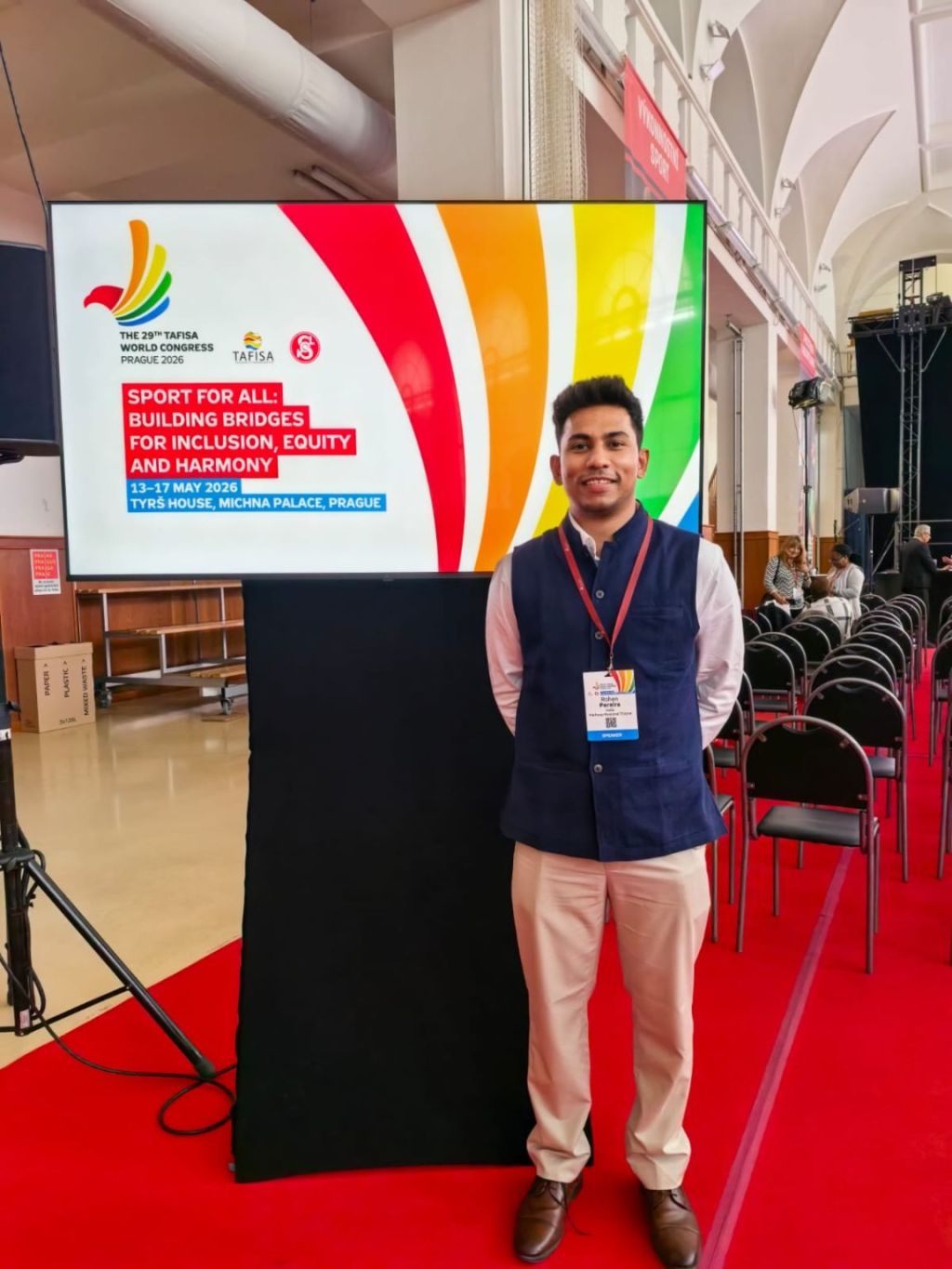
Rohan Pereira is a Regional Trainer for the Girls Positive and Safe Coaching Pathway, coordinating training and reporting across the Asia-Oceania region. In this reflection, he shares his experience attending the 29th TAFISA World Congress in Prague – his first international gathering of this scale – and what it meant to see practitioners and coaches brought into the centre of a global conversation about sport for all.
Arriving in Prague
Early in October 2025, while transitioning back to India after completing my master’s and continuing my engagement with TAFISA’s Girls Positive and Safe Coaching Pathway (Pathway) as a Regional Trainer, I received news that I had been selected as a speaker at the 29th TAFISA World Congress in Prague.
What made this feel special to me was seeing voices from the ground, coaches, trainers, and practitioners, being brought into the conversation in a meaningful way. Too often, discussions around sport for all are centred around policy, frameworks, and research, while the people directly working with communities remain in the background. This felt different. It felt like there was genuine space to share lived experiences, challenges, and learnings from the field itself. That truly did excite me. However, I also knew that as the Congress came closer, the nervousness would slowly start kicking in.
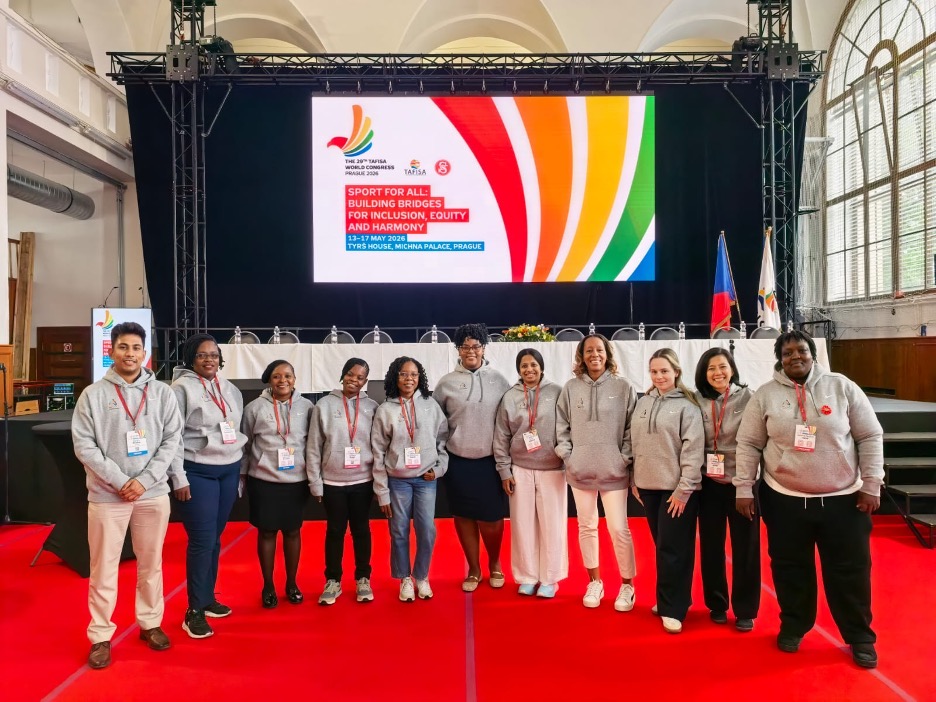
By May, the Congress had arrived quicker than expected. As I travelled to Prague alongside Pathway coaches and participants from Africa, Phillippines, Americas, and TAFISA members from other parts of the world, there was a shared feeling of nervousness and excitement amongst many of us. My 13-hour flight was filled with overthinking – what would the audience be like, would my experiences resonate, would I say something wrong? Even a rewatch of The Hangoverdid not really help calm my nerves. Yet somewhere amidst all the overthinking, I still carried confidence that the experiences we were bringing from the ground mattered.
For me, this was my first international gathering of this scale. Policymakers, researchers, sport for all leaders, and practitioners I had previously only seen on webinars, posters, or LinkedIn posts were suddenly right in front of me. And in the middle of all this, I realised that while I had a lot to learn from the people in the room, many of whom had travelled from across the world carrying their own experiences and learnings as well, I also had experiences and perspectives that people were genuinely interested in hearing about.
Conversations with fellow Pathway coaches, trainers, TAFISA team members, and other participants slowly eased that feeling. Very quickly, the Congress stopped feeling intimidating. Despite people coming from very different sporting and cultural contexts, there was a genuine openness to listen, learn, and share experiences with each other.
Voices from the Ground
I was fortunate to speak and represent the Girls Positive and Safe Coaching Pathway across two sessions – one focused on empowering communities through capacity building, where I shared the stage with stakeholders from the IOC, the Global Observatory for Gender Equality & Sport, and the World Flying Disc Federation; while the other focused on stories and experiences from alumni of the Pathway program.
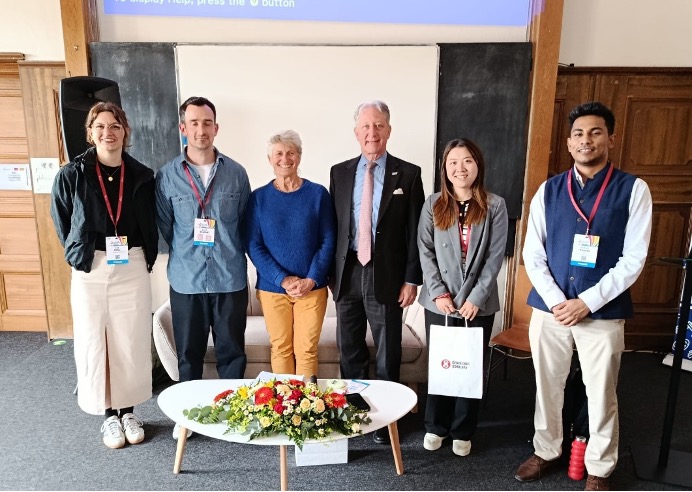
Across both sessions I participated in, one message kept coming up repeatedly: coaches impact far more than sporting performance – they shape how young people experience sport itself. More importantly, it highlighted why coaches need to be at the centre of conversations around the future of sport.
As part of the discussions, coaches and trainers from countries such as the Philippines, Botswana, Kenya, and India reflected on challenges around stereotypes, body image, safeguarding, menstruation, parental resistance, and retaining girls in sport. While the contexts were different, many of the experiences felt deeply connected. What stood out was how intentionally many coaches were trying to reshape sporting spaces to become safer and more supportive for girls. Many of these stories were deeply personal and rooted in their own journeys as coaches and practitioners.
Nina Javier, a coach and Pathway participant from the Philippines, shared something that particularly resonated with me. Speaking about her own understanding of empowerment and coaching, she noted:

I realized that when I thought of empowering others, I focused on making them like me – someone strong and confident. But through the Pathway, I understood the importance of focusing on the struggles girls were going through, and recognizing that each girl needs different forms of encouragement and growth. I needed to focus on the softer side of empowerment.
That idea of “soft empowerment” – understanding girls first rather than simply pushing them towards confidence or success – felt powerful to me, and reflected many of the conversations taking place throughout the Congress.
Similarly, Fathime Tibu, a Pathway Regional Trainer from Kenya, reflected on her own journey of growing up in a conservative community where girls were often not supported to participate in sport. Listening to her speak about finding confidence and purpose through football made her reflections on community engagement and creating safer and more inclusive sporting spaces feel deeply personal:
My journey is proof that when a community invests in girls, transformation becomes possible. We still have a long way to go. But together, we can build a future where every girl has a chance to dream, grow, lead, and succeed.
Hearing these experiences reinforced something I had been thinking about throughout the Congress – sport is not automatically positive. It has immense potential to create confidence, belonging, and opportunity, but only when approached intentionally and safely.
What encouraged me most was seeing coaches actively challenge this within their own communities.
Some reflected on learning to move away from rigid ideas of “empowerment” and instead understanding the different realities girls navigate. Others spoke about the need for creating safer spaces where conversations around menstruation, stereotypes, or emotional wellbeing were not treated as taboo. There were also discussions around engaging parents and communities differently so that girls were not only encouraged to join sport, but also supported to remain in it. More importantly, these stories came from people doing this work closely with communities every day.
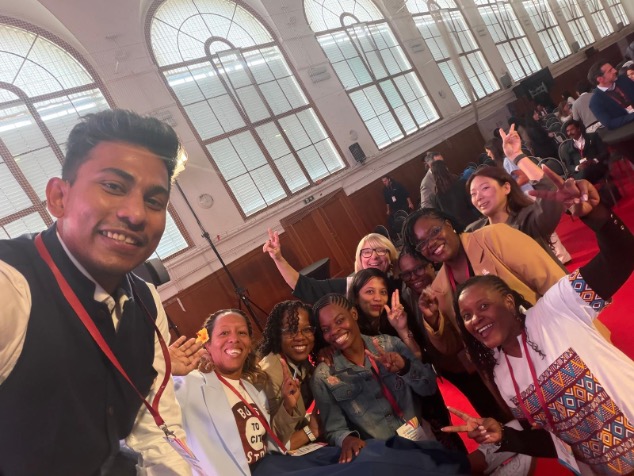
The discussions also highlighted why the Pathway feels so important. Between 2024-25, the program reached over 1,040 coaches and program managers across 18 countries through 13 partners. I was fortunate to first be involved as a community trainer, and later as a Regional Trainer coordinating training sessions and reporting across Asia-Oceania. That journey itself exposed me to the different contextual challenges girls face in accessing and remaining in sport – and why intentional coach education matters so much.
Looking Beyond the Sessions
One of the strongest learnings I carried back from Prague was the importance of creating more spaces where practitioners can speak for themselves. Too often, people closest to implementation remain absent from larger global conversations. Yet practitioners carry some of the most valuable forms of knowledge – lived experiences, contextual understanding, trust within communities, and honest reflections around both successes and challenges.
The Congress also reminded me that while evidence is critical – not just for donors, but also for learning and improving programs – it does not only exist in reports and numbers. It also exists in stories, observations, conversations, and lived experiences from the field.
At the same time, the experience reaffirmed the importance of investing in coaches as long-term change-makers. If we genuinely want safer and more inclusive sporting cultures, coaches cannot simply be treated as deliverers of programs. They need to be recognised as people shaping environments, relationships, and experiences for young people every single day.
Perhaps what struck me most was seeing how connected many of our struggles and aspirations were despite coming from entirely different parts of the world. Whether in India, Kenya, Botswana, or the Philippines, similar conversations around safety, stereotypes, confidence, belonging, and access continued to emerge. This was also something I reflected on while closing the alumni discussion. If we genuinely want sport to become safer and more inclusive, we need to move beyond isolated interventions and start building stronger networks of shared learning across communities, organisations, and regions. We also need to intentionally create more platforms where coaches and practitioners can share their lived experiences – not just as participants in programs, but as knowledge partners shaping the future of sport itself.
Most importantly, the discussions reinforced that while sport has immense potential to create positive futures, it is not automatically inclusive or safe. Creating meaningful change requires intentionality, long-term commitment, and a willingness to challenge many of the stereotypes and structures that continue to exclude girls from sporting spaces.
What I Carried Back Home
As I returned to India, I carried back far more than memories from my first global Congress.
I returned with a renewed sense of reassurance that efforts happening within communities do matter, that practitioners do have valuable knowledge to contribute, and that there are spaces slowly emerging where these voices are being heard more meaningfully.
Most importantly, I returned with renewed belief that creating safer and more inclusive sporting cultures requires collective effort. Not an isolated program, but long-term collaboration, listening, and intentional action.
And perhaps for the first time, I truly felt that practitioners like us were not just implementing change quietly in the background – we were also becoming part of shaping the larger conversation around sport for all.